What Kind of Work Is AI Good For?
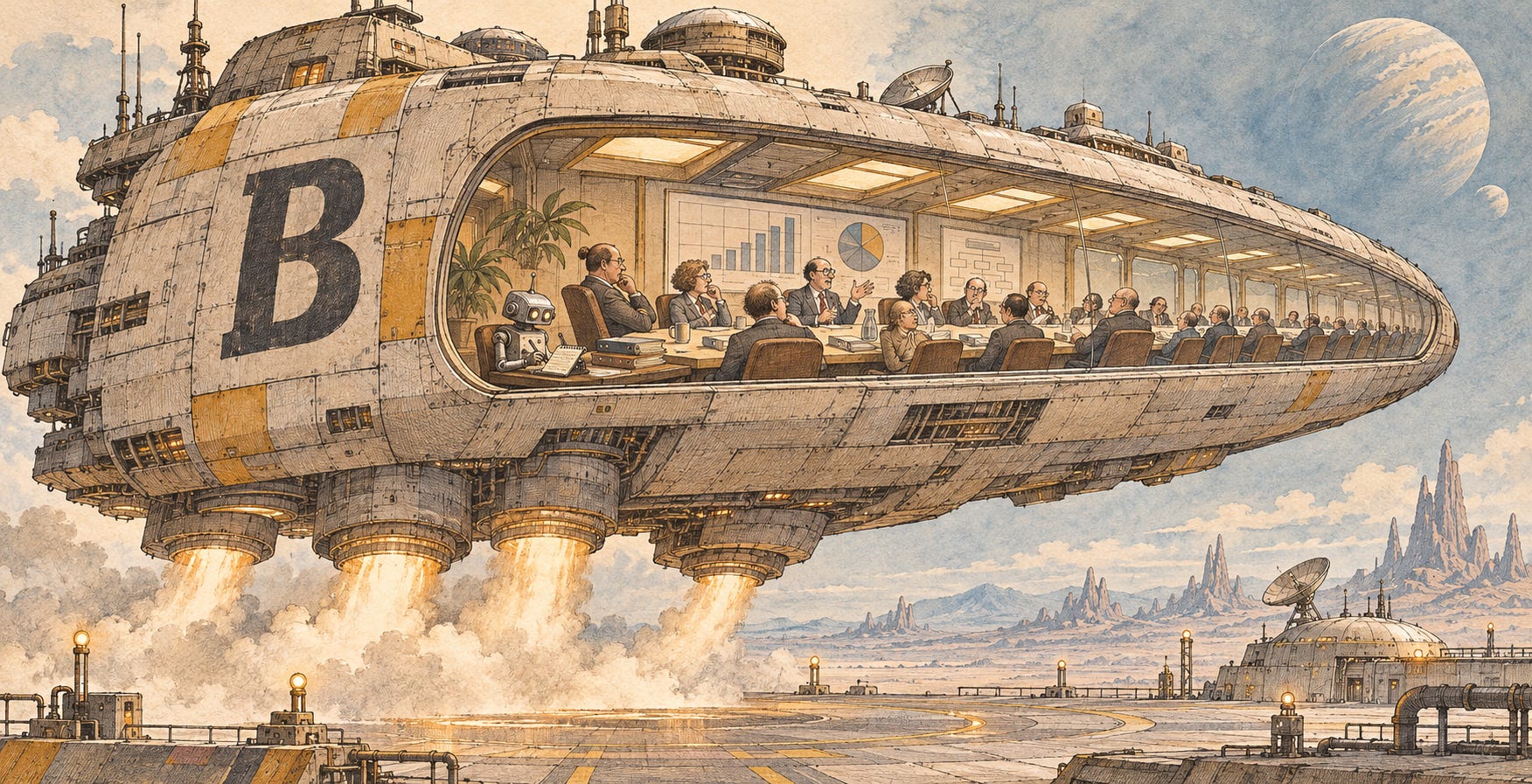
Original AI-generated illustration, created for this essay.
In Hitchhiker’s Guide to the Galaxy, Adams tells of a society that divided its members into three groups. Group A included leaders, scientists, thinkers and artists. Group B included middle management, consultants, advertising executives, telephone sanitizers and so on. Group C included manual laborers, manufacturers and farmers. Members of Groups A and C reached the conclusion that Group B was redundant and conspired to get rid of them. Under the pretense of impending doom, each group was to travel in a huge spaceship—an Ark—and Ark B was the first to depart.
The other two-thirds, of course, stayed at home and lived full, rich, and happy lives until they were all suddenly wiped out by a virulent disease contracted from a dirty telephone. Meanwhile, Arthur Dent, Ford Prefect, and an Ark-load of frozen middle management men have crashed into the prehistoric dawn of a small, blue-green planet circling an unregarded yellow sun at the unfashionable end of the Western Spiral Arm of the Galaxy. After a year or so they convene a meeting to consider their position, which is not, on the whole, good…
— Douglas Adams, The Hitch-Hiker’s Guide to the Galaxy, Fit the Sixth
At first glance, this is but an ingenious joke about humanity as we know it (much like his remark about needing instructions for a toothpick). But, as is often the case with Adams, this joke captures some serious truth. Adams puts his finger on a real social division. His groups apply to modern-day Earth, just as much as to his fictional Golgafrincham. And more importantly, those truths are extremely useful for explaining how to work with AI.
Recent developments have shifted the focus from AI as a chatbot to AI as an agent, meaning a function capable of executing autonomous actions and fulfilling tasks. And yet, there is a tremendous difference in the degree of success, depending on what kinds of tasks we are talking about.
It is most easily demonstrated with Group C. To perform their manual labor, the AI would have to operate robots and machinery as effectively as humans do. Well, let’s just say this future is not quite at hand yet.
I Tried the First Humanoid Home Robot. It Got Weird., Joanna Stern, The Wall Street Journal (2025).
This is not because manual labor is logically complex, but because converting physical facts to logic and reality to virtual representation is a much greater task than initially appears. On top of that, even a theoretically successful application will still depend on some mighty expensive hardware to carry it out. So, while this endeavor is definitely underway, it remains irrelevant for most of us.
Things are significantly different with regard to Groups A and B. Their work requires relatively small physical capabilities, and thus the expectation that it can be performed by AI remains viable. Still, attempts to use AI to generate original philosophy or fine art fail more often than not. In fact, the forgotten word “slop” was repurposed precisely for describing low-level AI output masquerading as quality work. This phenomenon is so common that this word became Merriam-Webster’s 2025 Word of the Year.
Distinguishing abstract from manual labor is easy. Adams’ genius and usefulness here lie in distinguishing A-work from B-work. To understand why AI excels at B-work while failing at A-work, we need to understand not only the nature of AI, but also the categorical difference between the two kinds of tasks.
While externally similar, the two kinds of tasks represent completely different kinds of mental operation. This is why it is so easy to look down on Group B. Their work appears to require no originality, no particular talents, no vision and not even strenuous work or endurance. This is why Adams caricatures them as flat-out redundant. Nevertheless, as he brilliantly points out, their function is indispensable. This is what his fictional people failed to understand. Just because this is a job anyone could have done, doesn’t mean it can remain undone altogether.
The better characterization of Group B is not that they are redundant, but that they are replaceable. This is why job security is such a big issue for this category of workers, and why the introduction of agentic AI creates so much anxiety within those sectors.
This anxiety is not without basis. AI really does excel in a lot of what B-workers do: absorbing and analyzing data, identifying patterns and correlations, converting one data format to another and so on. Think about tasks like synchronizing schedules, putting forms into an Excel sheet, or extracting action items from a meeting protocol (let alone transcribing it). These are all essential functions for a modern corporation, and would normally require dozens of human hours to carry out. Nowadays and with the right setup, AI can perform them much more reliably, in a fraction of the time and for a fraction of the cost.
So office workers are right to be concerned. The paradox here, though, is that the more someone resents AI because they are afraid it will take their job, the more likely it is to actually happen. However, the real risk is not that AI can replace them entirely. If they are replaced, it will likely not be with an AI, but with another worker who has learnt how to utilize AI in their workflow.
The reason it is very hard to completely replace a human with an AI, even for a simple job, is that while tasks can be categorically distinct, jobs rarely are. A manual laborer still needs to exercise minimal judgment; a brilliant thinker still needs to coherently organize their thoughts; and a middle manager still needs to have a certain degree of vision that AI inherently lacks.
We Let AI Run a Vending Machine. It Lost All the Money., The Wall Street Journal (2025; adversarial test).
In a nutshell, AI is based on imitation. It learns patterns from its training data and uses them to predict what output should follow a given input. Thus, the easier it is to imitate the work, the better AI will be at doing it.
Members of Group B have the largest predictable portion of their work. This means AI can have the largest impact on them, but that impact does not have to be negative. AI cannot replace an original thinker, but it also means an original thinker has less to gain from using AI. A B-worker who learns to harness the power of AI can exponentially increase their productivity. More importantly, it allows even a B-worker to focus on the A-work part of their job: forming a vision, seeing the big picture, directing and exercising practical and moral judgment.
Part of the reason we are drowning in slop is that many people think AI can convert B-work into A-work. Nothing could be further from the truth. A user who provided the model with no original insight to begin with, cannot generate one simply by prompting the model to “come up with something new”. Whenever we expect the AI to make an unpredictable decision, we set ourselves up for disappointment. This is where genuine human thinking has no replacement in the foreseeable future.
So even if someone is currently assigned to Ark B, AI can be their ticket to Ark A. But this will not be achieved by getting the AI to do the A work, and then taking credit for it. This is the equivalent of a middle manager exploiting a talented employee. Well, that rarely works with AI. In fact it is often made worse, because the B-person often lacks the judgment to recognize what they have received. Or maybe they do, but prefer to deny it, for when someone is trying to deceive, first of all they must deceive themselves. Then the model further praises that incompetence, creating a ridiculous feedback loop in which the fool is literally leading the blind.
AI Willy Wonka ‘experience’ in Glasgow, BBC News (2024).
Instead of giving the AI general instructions, it should be used to automate an already defined task. The user still needs to be responsible for planning and evaluating. The model can save effort, not replace creativity, vision and judgment.
Ultimately, it means recognizing that no one’s job is to fill in Excel sheets. This has always been a means to a greater end. The job is to keep a process running, to coordinate between different functions, to monitor a process and recognize when something goes wrong. Anyone who understands that and learns how to use AI to execute their plan, essentially becomes senior management, even if their job description remains the same.